Chlorophyll fluorescence and leaf nutritional status of passion fruit (Passiflora edulis f. flavicarpa) seedlings grown in different organic substrates
Abstract
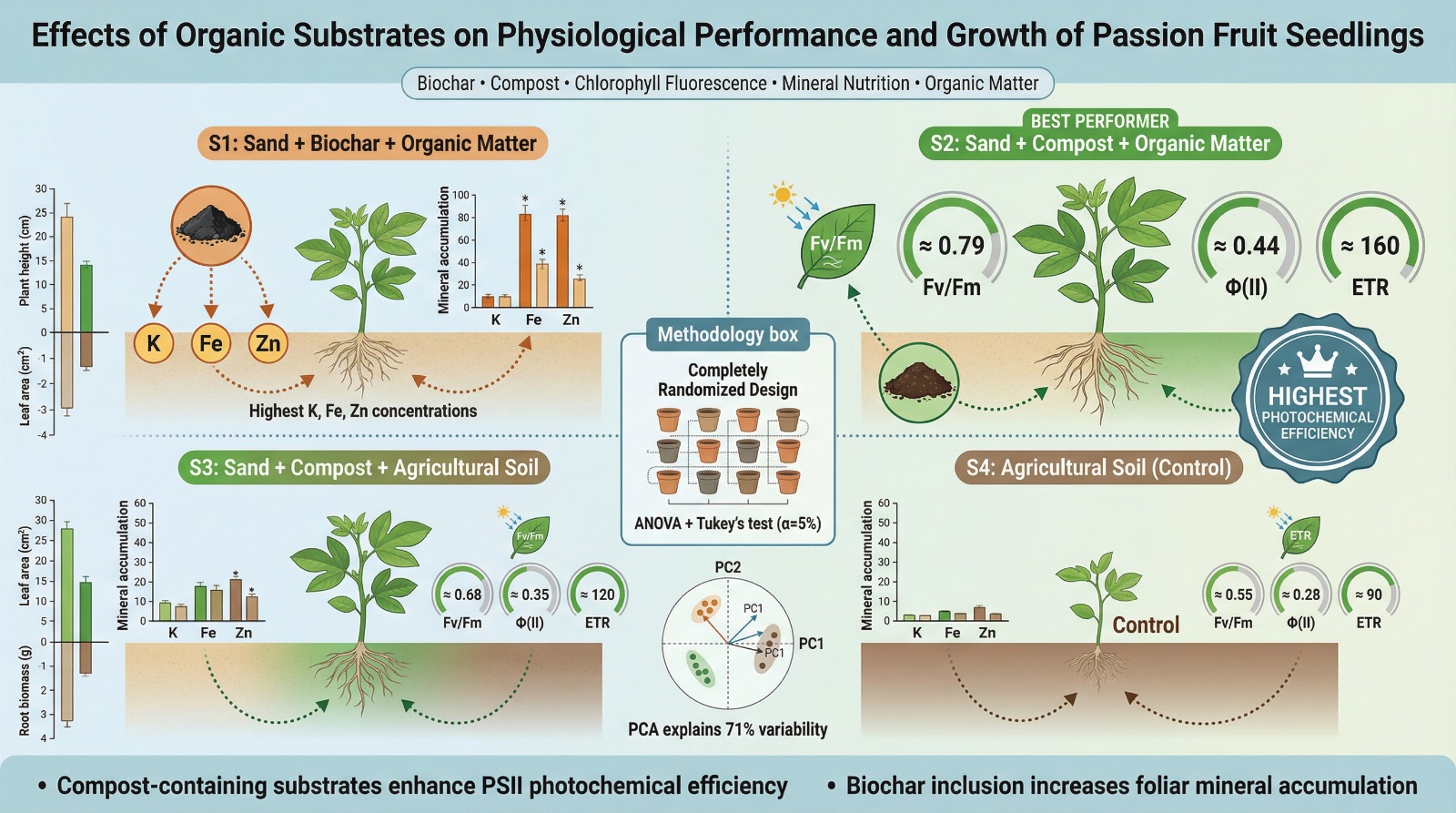
Passion fruit (Passiflora edulis f. flavicarpa) has high economic and nutritional value, and the nursery stage is crucial for its early development. The objective of the present study was to evaluate chlorophyll fluorescence, foliar nutritional status, and growth of passion fruit seedlings in response to four organic substrates: S1 (sand + biochar + organic matter), S2 (sand + compost + organic matter), S3 (sand + compost + agricultural soil), and S4 (agricultural soil), under a completely randomized design. The physiological variables Fv/Fm, Φ(II), and ETR were measured, as well as the foliar concentration of macro and micronutrients and growth variables, whose data were analyzed using ANOVA and Tukey's test (5%). Plants grown in substrate S2 showed the highest photochemical efficiency (Fv/Fm ≈ 0.79; Φ(II) ≈ 0.44; ETR ≈ 160), whereas those in substrate S1 exhibited the highest foliar concentrations of K, Fe, and Zn. The principal component analysis explained 71% of the total variability, associating substrate S2 with better physiological yield and growth. It can be concluded that substrates containing compost enhance PSII photochemical efficiency, while those including biochar are associated with greater foliar mineral accumulation.
Downloads
References
Bonifácio, T. C., Ribeiro, C. H. M., Carlos, R. P., & Costa, L. F. (2025). Different substrates in the emergence and development of Passiflora edulis F. Seedlings. Revista de Agricultura Neotropical, 12(2), e9316. https://doi.org/10.32404/rean.v12i2.9316
Da Silva, L. N., Lima, L. K. S., dos Santos, I. S., Sampaio, S. R., Filho, M. A. C. & de Jesus, O. N. (2023). Biometrics and physiological parameters of sour passion fruit seedlings produced on organic substrates. Australian Journal of Crop Science (AJCS), 17(2). 118-129. https://doi.org/10.21475/ajcs.23.17.02.p3549
De Lima, G. S., da Silva, A. A. R., Torres, R. A. F., Soares, L. A. A., Gheyi, H. R., da Silva, F. A., Nobre, R. G., de Azevedo, C. A. V., Lopes, K. P., & Chaves, L. H. G. (2023). NPK accumulation, physiology, and production of sour passion fruit under salt stress irrigated with brackish water in the phenological stages and K fertilization. Plants, 12(7), 1573. https://doi.org/10.3390/plants12071573
Faria, L. O., Souza, A. G.V., de Alvarenga, F. B., Silva, F. C. M., Junior, J. S. R., Amorim, V. A., Borges, L. P. & Matos, F. S. (2020). Passiflora edulis Growth Under Different Water Regimes Journal of Agricultural Science, 12(4). 231-231 https://doi.org/10.5539/jas.v12n4p231
Freire, J. L. O., Moreira, G. H. D., Araújo, N. S., & Medeiros, A. K. A. (2022). Efeitos do carvão vegetal na produção de mudas de maracujazeiro-amarelo. Revista Principia, 59(2), 527–546. http://dx.doi.org/10.18265/1517-0306a2021id4967
Hauer-Jákli, M., & Tränkner, M. (2019). Critical leaf magnesium thresholds and the impact of magnesium on plant growth and photo-oxidative defense: a systematic review and meta-analysis from 70 years of research. Frontiers in Plant Science, 10, 766. https://doi.org/10.3389/fpls.2019.00766
Instituto Nacional de Estadística y Censos (INEC). 2023. Anuario de Producción Agrícola. Quito, Ecuador. Disponible en https://www.ecuadorencifras.gob.ec/documentos/web-inec/Estadisticas_agropecuarias/espac/2023/Boletin_tecnico_ESPAC_2023.pdf
Lessa, C. I. N., de Sousa, G. G., Sousa, H. C., de Lacerda, C. F., da Silva, A. O. & Guilherme, J. M. S. (2023). Morphophysiology of passion-fruit seedlings in different substrates under different strategies of irrigation with brackish water. Revista Ambiente & Água, 18, e3166. https://doi.org/10.4136/ambi-agua.2907
Millaleo, R., Reyes-Díaz, M., Ivanov, A. G., Mora, M. L., & Alberdi, M. (2020). Manganese as essential and toxic element for plants: Transport, accumulation and signaling. Plant Physiology and Biochemistry, 151, 362–377. https://doi.org/10.1016/j.plaphy.2020.04.039
Ministerio de Agricultura y Ganadería (MAG). 2020. Boletín Económico Agrícola. Quito, Ecuador. Recuperado de: https://www.agricultura.gob.ec/boletin-economico-agricola/.
Ni, Y., Lin, K., Chen, K., Wu, C., & Chang, Y. (2020). Flavonoid Compounds and Photosynthesis in Passiflora Plant Leaves under Varying Light Intensities. Plants, 9(5), 633. https://doi.org/10.3390/plants9050633
Paixão, M. V. S., Denardi, B. E. F., Faian, M. S., Nandorf, R. J., & Felisberto, R. T. (2021). Substrates, emergence and initial development of passion fruit seedlings. Comunicata Scientiae, 12, e3515. https://doi.org/10.14295/cs.v12.3515.
Saleem, M. H., Usman, K., Rizwan, M., Al Jabri, H., & Alsafran, M. (2022). Functions and strategies for enhancing zinc availability in plants for sustainable agriculture. Frontiers in Plant Science, 13, 1033092. https://doi.org/10.3389/fpls.2022.1033092
Santos, C. C., Bernardes, R. da S., Goelzer, A., Scalon, S. de P. Q., & Vieira, M. do C. (2020). Chicken manure and luminous availability influence gas exchange and photochemical processes in Alibertia edulis seedlings. Engenharia Agrícola, 40(4), 420-432. https://doi.org/10.1590/1809-4430-eng.agric.v40n4p420-432/2020.
Silva, G. S., & Souza, M. M. (2020). Origin of the cultivated passion fruit Passiflora edulis f. flavicarpa and genomic relationships among species of the subgenera Decaloba and Passiflora. Plant Biology, 22(3), 533-540. https://doi.org/10.1111/plb.13100
Su, X., Xin, Y., Zhou, C., Geng, S., Chen, S., Cai, N., Tang, J., Chen, L. & Xu, Y. (2024). The response and evaluation of morphology, physiology and biochemistry of triploid Passiflora edulis under drought treatment. Plantas, 13(12), 1685. https://doi.org/10.3390/plants13121685
Sun, D., Hu, C., Yang, Y., Wang, H., Yan, T., Wu, C., Hu, Z., Lu, X., & Zhou, B. (2025). Synergistic effects of supplemental lighting and foliar phosphorus application on flowering in passion fruit (Passiflora edulis). Horticulturae, 11(5), 478. https://doi.org/10.3390/horticulturae11050478
Tomaškinová, J., Brestič, M., Zivčák, M., & Kalaji, H. M. (2025). The impact of abiotic environmental stressors on chlorophyll fluorescence and photosynthetic performance. Agronomy, 15(2), 263. https://doi.org/10.3390/agronomy15020263
Wu, D., Zhang, Y., Gu, W., Feng, Z., Xiu, L., Zhang, W., & Chen, W. (2023). Long term co‐application of biochar and fertilizer could increase soybean yield under continuous cropping: insights from photosynthetic physiology. Journal Of The Science Of Food and Agriculture, 104(5), 3113-3122. https://doi.org/10.1002/jsfa.13202
Yang, Y., Ye, C., Zhang, W., Zhu, X., Li, H., Yang, D., Ahmed, W., & Zhao, Z. (2023). Elucidating the impact of biochar with different carbon/nitrogen ratios on soil biochemical properties and rhizosphere bacterial communities of flue-cured tobacco plants. Frontiers in Plant Science, 14, 1250669. https://doi.org/10.3389/fpls.2023.1250669
Zhang, J., Li, T., & Wang, H. (2023). Effects of exogenous zinc on the physiological function of Passiflora edulis seedlings. Plants, 12(20), 3643. https://pmc.ncbi.nlm.nih.gov/articles/PMC10590096/
Zhou, B., Yang, Y., Sun, D., et al. (2023). Nitrogen regulation of chlorophyll fluorescence and photosynthetic performance in horticultural crops. Agronomy, 13(7), 1749. https://doi.org/10.3390/agronomy13071749.
Copyright (c) Luís Angel Giler Cool, Adriana Celi Soto, Galo Cedeño García, George Cedeño-García

This work is licensed under a Creative Commons Attribution-NonCommercial-ShareAlike 4.0 International License.