Atividades antioxidantes e antimicrobianas dos extratos sustentáveis de sementes de Salvia hispanica L. contra bactérias Gram-positivas e Gram-negativas
Resumo
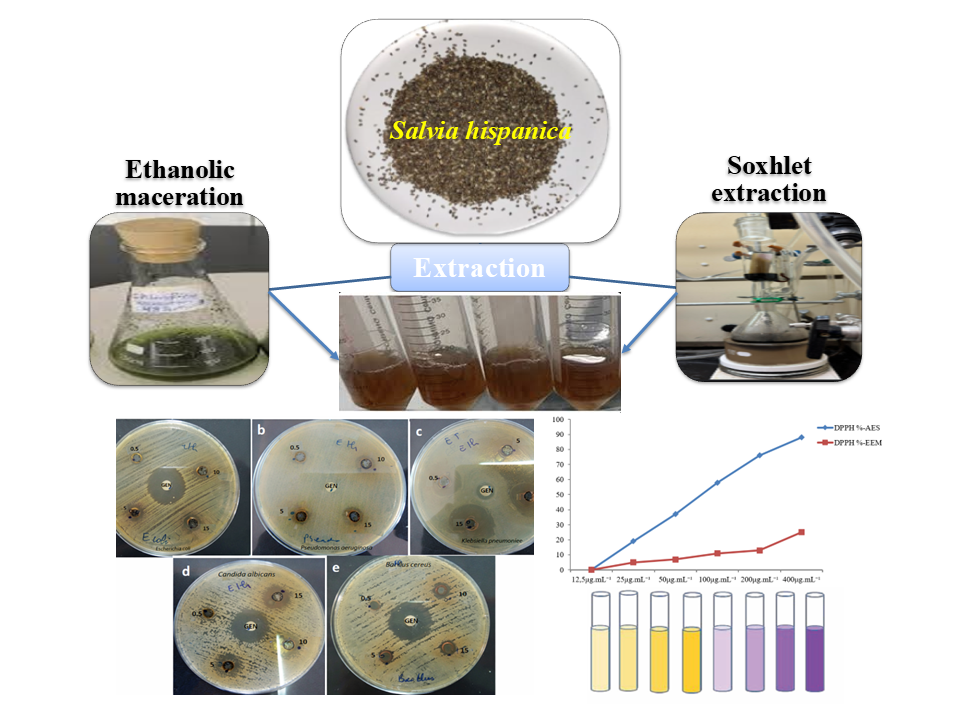
As sementes de Salvia hispanica L. (chia) são ricas em compostos bioativos com propriedades antioxidantes e antimicrobianas, tornando-se ingredientes naturais valiosos para aplicações alimentares e agroindustriais. A contaminação de alimentos por bactérias Gram-positivas e Gram-negativas continua sendo um grande desafio para a segurança alimentar, destacando a necessidade de conservantes naturais sustentáveis. Este estudo teve como objetivo comparar dois métodos de extração verde para recuperar compostos bioativos de sementes escuras de chia da Argélia e avaliar as atividades antioxidante e antimicrobiana dos extratos obtidos frente a bactérias Gram-positivas e Gram-negativas. Foram aplicadas extração aquosa Soxhlet e maceração etanólica. Os extratos foram analisados quanto ao teor total de fenóis e flavonoides, atividade antioxidante (ensaio DPPH) e atividade antimicrobiana pelo método de difusão em disco contra nove cepas microbianas, incluindo bactérias Gram-positivas e Gram-negativas e Candida albicans. O extrato aquoso Soxhlet apresentou o maior teor total de fenóis e forte atividade antioxidante (88 % de inibição DPPH a 400 μg.mL-1). O extrato de maceração etanólica foi mais rico em flavonoides e mostrou atividade antimicrobiana moderada, dependente da dose. As bactérias Gram-positivas (Staphylococcus aureus e Listeria monocytogenes) foram as mais sensíveis (até 12 ± 1 mm), enquanto as Gram-negativas foram geralmente mais resistentes, exceto Klebsiella pneumoniae (15 ± 1 mm a 15 mg.mL-1). Candida albicans apresentou alta suscetibilidade (14 ± 1 mm). Extratos de sementes de chia obtidos por métodos verdes demonstram atividades antioxidantes significativas e atividade antimicrobiana moderada, apoiando seu potencial uso na conservação de alimentos, desenvolvimento de produtos sustentáveis e aplicações agroindustriais ecológicas.
Downloads
Referências
Capitani, M. I., Spotorno, V., Nolasco, S. M., & Tomás, M. C. (2012). Physicochemical and functional characterization of by-products from chia (Salvia hispanica L.) seeds of Argentina. LWT - Food Science and Technology, 50(2), 478–485. https://doi.org/10.1016/j.lwt.2011.07.012
CA-SFM. (2025). Société Française de Microbiologie – Comité de l’Antibiogramme de la SFM (version 1.1). Paris: Société Française de Microbiologie. https://www.sfm-microbiologie.org/wp-content/uploads/2025/07/CASFM2025_V1.1-JUILLET-2025.pdf
Chang, C., Yang, M., Wen, H., & Chern, J. (2002). Estimation of total flavonoid content in propolis by two complementary colorimetric methods. Journal of Food and Drug Analysis, 10(3), 178–182. https://doi.org/10.38212/2224-6614.2748
Clarke, C. J., Tu, W. C., Levers, O., Brohl, A., & Hallett, J. P. (2018). Green and sustainable solvents in chemical processes. Chemical Reviews, 118(2), 747–800. https://doi.org/10.1021/acs.chemrev.7b00571
Cravotto, C., Rapinel, V., Nguyen Thanh, B., Bonet García, R., Bartier, M., Claux, O., Jacques, L., Tabasso, S., Barrajón Catalán, E., & Fabiano Tixier, A. S. (2025). Sustainable grape seed oil processing: Green solvent extraction and byproduct valorisation. Food and Bioproducts Processing, 149, 428–438. https://doi.org/10.1016/j.fbp.2024.12.006
Demirkol, O., Ersatır, M., Giray, E. S., & Kırıcı, S. (2022). Comparison of the effects of green and sustainable extraction methods on the extraction yield and chemical composition of Ruta chalepensis roots. Sustainable Chemistry and Pharmacy, 29, 100750. https://doi.org/10.1016/j.scp.2022.100750
Dib, H., Seladji, M., Bencheikh, F. Z., Faradji, M., Benammar, C., & Belarbi, M. (2021). Phytochemical screening and antioxidant activity of Salvia hispanica. Journal of Pharmaceutical Research International, 33, 167–174. https://doi.org/10.9734/jpri/2021/v33i41A32314
Gonzalez Pastor, R., Carrera Pacheco, S. E., Zúñiga Miranda, J., Rodríguez Pólit, C., Mayorga Ramos, A., Guamán, L. P., & Barba Ostria, C. (2023). Current landscape of methods to evaluate antimicrobial activity of natural extracts. Molecules, 28(3), 1068. https://doi.org/10.3390/molecules28031068
Kaurinovic, B., & Vastag, D. (2019). Flavonoids and phenolic acids as potential natural antioxidants. In E. Shalaby (Ed.), Antioxidants. IntechOpen. 418 p https://doi.org/10.5772/intechopen.83731
Knez Hrnčič, M., Ivanovski, M., Cör, D., & Knez, Ž. (2019). Chia Seeds (Salvia hispanica L.): An Overview-Phytochemical Profile, Isolation Methods, and Application. Molecules, 25(1), 11. https://doi.org/10.3390/molecules25010011
Matuschek, E., Brown, D. F. J., & Kahlmeter, G. (2014). Development of the EUCAST disk diffusion antimicrobial susceptibility testing method and its implementation in routine microbiology laboratories. Clinical Microbiology and Infection, 20(4), O255–O266. https://doi.org/10.1111/1469-0691.12373
Motyka, S., Kusznierewicz, B., Ekiert, H., Korona Głowniak, I., & Szopa, A. (2023). Comparative analysis of metabolic variations, antioxidant profiles and antimicrobial activity of Salvia hispanica (chia) seed, sprout, leaf, flower, root and herb extracts. Molecules, 28(6), 2728. https://doi.org/10.3390/molecules28062728
Najafi, Z., Zahran, H., Şahin Yeşilçubuk, N., & Gürbüz, H. (2022). Effect of different extraction methods on saffron antioxidant activity, total phenolic and crocin contents, and the protective effect of saffron extract on the oxidative stability of common vegetable oils. Grasas y Aceites, 73(4), e480. https://doi.org/10.3989/gya.0783211
Pérez, C., Pauli, M., & Bazerque, P. (1990). An antibiotic assay by the agar well diffusion method. Acta Biologiae et Medicinae Experimentalis, 113–115. https://www.researchgate.net/publication/303960600_An_antibiotic_assay_by_the_agar_well_diffusion_method
Rahmoune, I., Karoune, S., Azzam, C., Saad, S., Foughalia, A., Sarri, M., & Kechebar, M. S. A. (2024). In vitro antioxidant, antimicrobial and antidiabetic properties of the organic fraction of distillate of Salvia hispanica seeds. Revista Agrária Acadêmica, 7(5), 19–33. https://doi.org/10.32406/v7n5/2024/19 33/agrariacad
Rahmoune, I., Karoune, S., Saad, S., & Kechebar, M. S. (2025). Comparative evaluation of extraction methods on the phytochemical content and biological activities of Salvia hispanica (Chia) seed extracts. Journal Algérien des Régions Arides, 18(2), 43–51. https://asjp.cerist.dz/en/article/272442
Segura-Campos, M. R., Ciau-Solís, N., Rosado-Rubio, G., Chel-Guerrero, L., & Betancur-Ancona, D. (2014). Physicochemical characterization of chia (Salvia hispanica) seed oil from Yucatán, México. Agricultural Sciences, 5(3), 220–226. https://doi.org/10.4236/as.2014.53025
Silva, L. A., Sinnecker, P., Cavalari, A. A., Sato, A. C. K., & Perrechil, F. A. (2022). Extraction of chia seed mucilage: Effect of ultrasound application. Food Chemistry Advances, 1, 100024. https://doi.org/10.1016/j.focha.2022.100024
Singleton, V. L., & Rossi, J. A. (1965). Colorimetry of total phenolics with phosphomolybdic–phosphotungstic acid reagents. American Journal of Enology and Viticulture, 16, 144–158.
https://www.ajevonline.org/content/16/3/144?utm_source=chatgpt.com
Sultana, B., Anwar, F., & Ashraf, M. (2009). Effect of extraction solvent/technique on the antioxidant activity of selected medicinal plant extracts. Molecules, 14(6), 2167–2180. https://doi.org/10.3390/molecules14062167
Tavares, L. S., Junqueira, L. A., de Oliveira Guimarães, Í. C., & de Resende, J. V. (2018). Cold extraction method of chia seed mucilage (Salvia hispanica L.): Effect on yield and rheological behavior. Journal of Food Science and Technology, 55(2), 457-466. https://doi.org/10.1007/s13197 017 2954 4
Tavera-Hernández, R., Jiménez-Estrada, M., Alvarado-Sansininea, J. J., & Huerta-Reyes, M. (2023). Chia (Salvia hispanica L.), a pre-Hispanic food in the treatment of diabetes mellitus: Hypoglycemic, antioxidant, anti-inflammatory, and inhibitory properties of α-glucosidase and α-amylase, and in the prevention of cardiovascular disease. Molecules, 28(24), 8069. https://doi.org/10.3390/molecules28248069
Topçu, G., Ay, M., Bilici, A., Sarikürkcü, C., Öztürk, M., & Ulubelen, A. (2007). A new flavone from antioxidant extracts of Pistacia terebinthus. Food Chemistry, 103(3), 816–822. https://doi.org/10.1016/j.foodchem.2006.09.028
Ullah, R., Nadeem, M., Khalique, A., Imran, M., Mehmood, S., Javid, A., & Hussain, J. (2016). Nutritional and therapeutic perspectives of chia (Salvia hispanica L.): A review. Journal of Food Science and Technology, 53(4), 1750–1758. https://doi.org/10.1007/s13197-015-1967-0
Direitos de Autor (c) 2026 Khawla Zahra Hadef, Amina Attou, Nour el houda Madjidi

This work is licensed under a Creative Commons Attribution-NonCommercial-ShareAlike 4.0 International License.