Antioxidant and antimicrobial activities of sustainable Salvia hispanica L. seed extracts against gram-positive and gram-negative bacteria
Abstract
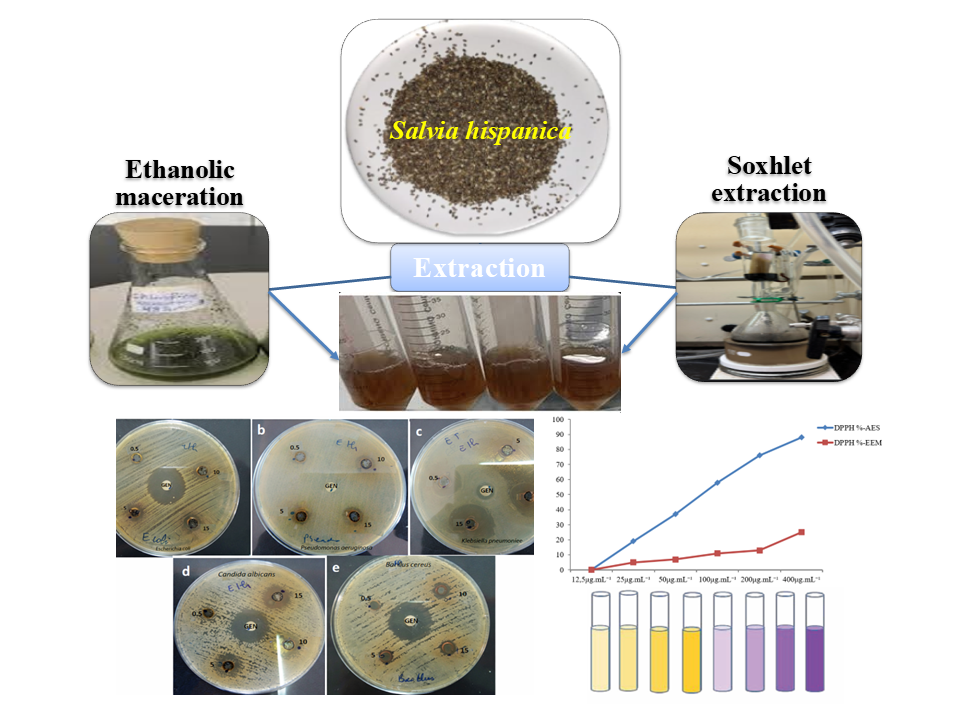
Salvia hispanica L. (chia) seeds are rich in bioactive compounds with antioxidant and antimicrobial properties, making them valuable natural ingredients for food and agro-industrial applications. Food contamination by Gram-positive and Gram-negative bacteria remains a major challenge for food safety, highlighting the need for sustainable natural preservatives. This study aimed to compare two green extraction methods for recovering bioactive compounds from Algerian dark chia seeds and to evaluate the antioxidant and antimicrobial activities of the resulting extracts against Gram-positive and Gram-negative bacteria. Aqueous Soxhlet extraction and ethanolic maceration were applied. Extracts were analyzed for total phenolics and flavonoids, antioxidant activity (DPPH assay), and antimicrobial activity using the disc diffusion method against nine microbial strains, including Gram-positive and Gram-negative bacteria and Candida albicans. The aqueous Soxhlet extract exhibited the highest total phenolic content and strong antioxidant activity (88 % DPPH inhibition at 400 μg.mL-1). The ethanolic maceration extract was richer in flavonoids and showed moderate, dose-dependent antimicrobial activity. Gram-positive bacteria (Staphylococcus aureus and Listeria monocytogenes) were most sensitive (up to 12 ± 1 mm), while Gram-negative bacteria were generally more resistant, except Klebsiella pneumoniae (15 ± 1 mm at 15 mg.mL-1). Candida albicans was highly susceptible (14 ± 1 mm). Green-extracted chia seed extracts demonstrate significant antioxidant and moderate antimicrobial activities, supporting their potential use in food preservation, sustainable product development, and eco-friendly agro-industrial applications.
Downloads
References
Capitani, M. I., Spotorno, V., Nolasco, S. M., & Tomás, M. C. (2012). Physicochemical and functional characterization of by-products from chia (Salvia hispanica L.) seeds of Argentina. LWT - Food Science and Technology, 50(2), 478–485. https://doi.org/10.1016/j.lwt.2011.07.012
CA-SFM. (2025). Société Française de Microbiologie – Comité de l’Antibiogramme de la SFM (version 1.1). Paris: Société Française de Microbiologie. https://www.sfm-microbiologie.org/wp-content/uploads/2025/07/CASFM2025_V1.1-JUILLET-2025.pdf
Chang, C., Yang, M., Wen, H., & Chern, J. (2002). Estimation of total flavonoid content in propolis by two complementary colorimetric methods. Journal of Food and Drug Analysis, 10(3), 178–182. https://doi.org/10.38212/2224-6614.2748
Clarke, C. J., Tu, W. C., Levers, O., Brohl, A., & Hallett, J. P. (2018). Green and sustainable solvents in chemical processes. Chemical Reviews, 118(2), 747–800. https://doi.org/10.1021/acs.chemrev.7b00571
Cravotto, C., Rapinel, V., Nguyen Thanh, B., Bonet García, R., Bartier, M., Claux, O., Jacques, L., Tabasso, S., Barrajón Catalán, E., & Fabiano Tixier, A. S. (2025). Sustainable grape seed oil processing: Green solvent extraction and byproduct valorisation. Food and Bioproducts Processing, 149, 428–438. https://doi.org/10.1016/j.fbp.2024.12.006
Demirkol, O., Ersatır, M., Giray, E. S., & Kırıcı, S. (2022). Comparison of the effects of green and sustainable extraction methods on the extraction yield and chemical composition of Ruta chalepensis roots. Sustainable Chemistry and Pharmacy, 29, 100750. https://doi.org/10.1016/j.scp.2022.100750
Dib, H., Seladji, M., Bencheikh, F. Z., Faradji, M., Benammar, C., & Belarbi, M. (2021). Phytochemical screening and antioxidant activity of Salvia hispanica. Journal of Pharmaceutical Research International, 33, 167–174. https://doi.org/10.9734/jpri/2021/v33i41A32314
Gonzalez Pastor, R., Carrera Pacheco, S. E., Zúñiga Miranda, J., Rodríguez Pólit, C., Mayorga Ramos, A., Guamán, L. P., & Barba Ostria, C. (2023). Current landscape of methods to evaluate antimicrobial activity of natural extracts. Molecules, 28(3), 1068. https://doi.org/10.3390/molecules28031068
Kaurinovic, B., & Vastag, D. (2019). Flavonoids and phenolic acids as potential natural antioxidants. In E. Shalaby (Ed.), Antioxidants. IntechOpen. 418 p https://doi.org/10.5772/intechopen.83731
Knez Hrnčič, M., Ivanovski, M., Cör, D., & Knez, Ž. (2019). Chia Seeds (Salvia hispanica L.): An Overview-Phytochemical Profile, Isolation Methods, and Application. Molecules, 25(1), 11. https://doi.org/10.3390/molecules25010011
Matuschek, E., Brown, D. F. J., & Kahlmeter, G. (2014). Development of the EUCAST disk diffusion antimicrobial susceptibility testing method and its implementation in routine microbiology laboratories. Clinical Microbiology and Infection, 20(4), O255–O266. https://doi.org/10.1111/1469-0691.12373
Motyka, S., Kusznierewicz, B., Ekiert, H., Korona Głowniak, I., & Szopa, A. (2023). Comparative analysis of metabolic variations, antioxidant profiles and antimicrobial activity of Salvia hispanica (chia) seed, sprout, leaf, flower, root and herb extracts. Molecules, 28(6), 2728. https://doi.org/10.3390/molecules28062728
Najafi, Z., Zahran, H., Şahin Yeşilçubuk, N., & Gürbüz, H. (2022). Effect of different extraction methods on saffron antioxidant activity, total phenolic and crocin contents, and the protective effect of saffron extract on the oxidative stability of common vegetable oils. Grasas y Aceites, 73(4), e480. https://doi.org/10.3989/gya.0783211
Pérez, C., Pauli, M., & Bazerque, P. (1990). An antibiotic assay by the agar well diffusion method. Acta Biologiae et Medicinae Experimentalis, 113–115. https://www.researchgate.net/publication/303960600_An_antibiotic_assay_by_the_agar_well_diffusion_method
Rahmoune, I., Karoune, S., Azzam, C., Saad, S., Foughalia, A., Sarri, M., & Kechebar, M. S. A. (2024). In vitro antioxidant, antimicrobial and antidiabetic properties of the organic fraction of distillate of Salvia hispanica seeds. Revista Agrária Acadêmica, 7(5), 19–33. https://doi.org/10.32406/v7n5/2024/19 33/agrariacad
Rahmoune, I., Karoune, S., Saad, S., & Kechebar, M. S. (2025). Comparative evaluation of extraction methods on the phytochemical content and biological activities of Salvia hispanica (Chia) seed extracts. Journal Algérien des Régions Arides, 18(2), 43–51. https://asjp.cerist.dz/en/article/272442
Segura-Campos, M. R., Ciau-Solís, N., Rosado-Rubio, G., Chel-Guerrero, L., & Betancur-Ancona, D. (2014). Physicochemical characterization of chia (Salvia hispanica) seed oil from Yucatán, México. Agricultural Sciences, 5(3), 220–226. https://doi.org/10.4236/as.2014.53025
Silva, L. A., Sinnecker, P., Cavalari, A. A., Sato, A. C. K., & Perrechil, F. A. (2022). Extraction of chia seed mucilage: Effect of ultrasound application. Food Chemistry Advances, 1, 100024. https://doi.org/10.1016/j.focha.2022.100024
Singleton, V. L., & Rossi, J. A. (1965). Colorimetry of total phenolics with phosphomolybdic–phosphotungstic acid reagents. American Journal of Enology and Viticulture, 16, 144–158.
https://www.ajevonline.org/content/16/3/144?utm_source=chatgpt.com
Sultana, B., Anwar, F., & Ashraf, M. (2009). Effect of extraction solvent/technique on the antioxidant activity of selected medicinal plant extracts. Molecules, 14(6), 2167–2180. https://doi.org/10.3390/molecules14062167
Tavares, L. S., Junqueira, L. A., de Oliveira Guimarães, Í. C., & de Resende, J. V. (2018). Cold extraction method of chia seed mucilage (Salvia hispanica L.): Effect on yield and rheological behavior. Journal of Food Science and Technology, 55(2), 457-466. https://doi.org/10.1007/s13197 017 2954 4
Tavera-Hernández, R., Jiménez-Estrada, M., Alvarado-Sansininea, J. J., & Huerta-Reyes, M. (2023). Chia (Salvia hispanica L.), a pre-Hispanic food in the treatment of diabetes mellitus: Hypoglycemic, antioxidant, anti-inflammatory, and inhibitory properties of α-glucosidase and α-amylase, and in the prevention of cardiovascular disease. Molecules, 28(24), 8069. https://doi.org/10.3390/molecules28248069
Topçu, G., Ay, M., Bilici, A., Sarikürkcü, C., Öztürk, M., & Ulubelen, A. (2007). A new flavone from antioxidant extracts of Pistacia terebinthus. Food Chemistry, 103(3), 816–822. https://doi.org/10.1016/j.foodchem.2006.09.028
Ullah, R., Nadeem, M., Khalique, A., Imran, M., Mehmood, S., Javid, A., & Hussain, J. (2016). Nutritional and therapeutic perspectives of chia (Salvia hispanica L.): A review. Journal of Food Science and Technology, 53(4), 1750–1758. https://doi.org/10.1007/s13197-015-1967-0
Copyright (c) 2026 Khawla Zahra Hadef, Amina Attou, Nour el houda Madjidi

This work is licensed under a Creative Commons Attribution-NonCommercial-ShareAlike 4.0 International License.