Economic assessment of sheep synchronization protocol
Abstract
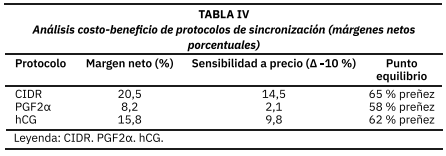
The study e valuat ed the ec onomic impact o f tw o o vulation synchronization protocols applied to hair sheep for laparoscopic insemination. To achieve this objective, the investment cost per synchronized ewe was analyzed, considering that the data obtained are estimates and may vary according to temporal context and particular experimental conditions. In methodological terms, the calculation of individual costs for each protocol included materials used in synchronization, as well as vitamins, antibiotics, instruments required for insemination, and tools used in pregnancy diagnosis. The goal is to determine, in cost-benefit terms, which protocol proves more efficient and profitable in production practice, providing useful information for resource optimization and improvement of reproductive outcomes in tropical sheep systems. The results obtained allow us to conclude that, overall, the intravaginal sponge protocol proved to be the most profitable and effective in economic and reproductive factors for hair sheep in tropical environments, surpassing the protocol using Controlled Intravaginal Drug Release devices. This protocol achieved an estrus presentation rate of 70 %, compared to 40 % for Controlled Intravaginal Drug Release, and produces a higher economic return for each monetary unit invested, confirming its status as the most effective option for tropical sheep systems.
Downloads
References
Dijkhuizen AA, Huirne RBM, Jalvingh AW. Economic analysis of animal diseases and their control. Prev. Vet. Med. [Internet]. 1995; 25(2):135–149. doi: https://doi.org/c9x4n9 DOI: https://doi.org/10.1016/0167-5877(95)00535-8
Freire FV, Agüero MD, Ponce M, Vigliocco A, Sandoval G. Análisis económico de sistemas productivos ovinos de Córdoba, Argentina: estudio de casos. Agriscientia. [Internet]. 2013; 30(1):37–47. Disponible en: https://goo.su/tUNOLx DOI: https://doi.org/10.31047/1668.298x.v30.n1.6050
Abbot t KA . Cos t –benefit e v aluation o f ar tificial insemination for genetic improvement of wool-producing sheep. Aust. Vet. J. [Internet]. 1994; 71(11):353–360. doi: https://doi.org/cc6sv2 DOI: https://doi.org/10.1111/j.1751-0813.1994.tb00926.x
Díaz-Sánchez C, Jaramillo-Villanueva JL, Bustamante- González Á , Vargas López S, Delgado -Alvarado A , Hernández-Mendo O, Casiano-Ventura MA. Evaluación de la rentabilidad y competitividad de los sistemas de producción de ovinos en la región de Libres, Puebla. Rev. Mex. Cienc. Pecu. 2018; 9(2):263–277. doi: https://doi.org/qzvf DOI: https://doi.org/10.22319/rmcp.v9i2.4495
Mohan K, Kumar N. Comparative evaluation of estrus synchronization protocols on reproductive performance and estrus behavior in Barbados Black Belly sheep. Vet. World. [Internet]. 2023; 16(11):2244–2249. doi: https://doi.org/qzvg DOI: https://doi.org/10.14202/vetworld.2023.2244-2249
Orozco NS. Evaluación de dos protocolos de sincronización en ovejas de pelo de la estación experimental Pastaza. [Tesis de pregrado]. Riobamba, Ecuador: Escuela Superior Politécnica de Chimborazo; 2023; 76 p. Disponible en: https://goo.su/3fHUW
Arroyo-Ledezma J, De la Torre-Barrera J, Ávila-Serrano NY. Respuesta reproductiva de ovejas de pelo sincronizadas con progesterona o prostaglandinas. Agrociencia . [Internet]. 2013; 47(7):661–670. Disponible en: https://goo.su/ULrtJYV
Nakafeero A , Gonzalez-Bulnes A , Martinez-Ros P. Use of short-term CIDR-based protocols for oestrus synchronisation in goats at tropical and subtropical latitudes. Animals. [Internet]. 2024; 14(11):1560. doi: https://doi.org/qzvj DOI: https://doi.org/10.3390/ani14111560
De K, Kumar D, Balaganur K, Naqvi SMK. Effect of environmental factors on estrus synchronization and artificial insemination success in farmers’ flocks of sheep under semi-arid tropical region. Reprod. Domest. Anim. 2020; 55(7):777-784. doi: https://doi.org/qzvm DOI: https://doi.org/10.1111/rda.13683