First comprehensive survey of Ixodid tick populations on Arabian-Barb horses in Northeastern Algeria: Species inventory and abiotic factors influence
Abstract
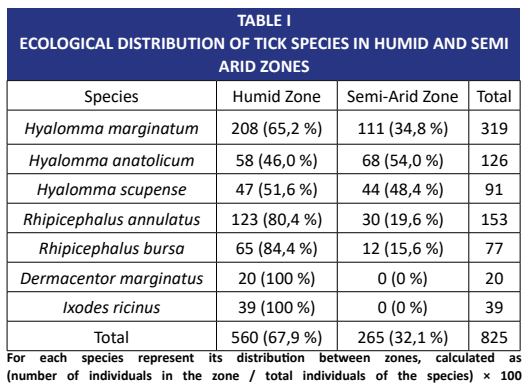
Ticks infestation has been shown to be a real health threat to horses in the Mediterranean basin. To identify the environmental factors underlying this risk, a prospective study was carried out from April to September 2024 on 67 Arabian-Barb horses distributed over six different climatic and geographic sites, ranging from the humid coastal plains of the province El Tarf (4 sites, n = 46, altitude 50-300 m) to the semi- arid interior highlands of the province of Tébessa (2 sites, n= 21, altitude 400-700 m). A total of 825 ticks were manually collected, according to a standardized five-minute inspection protocol, and differentiated microscopically through a detailed morphological analysis of specific characteristics.The results showed that slightly more than the third of the horses were infested (overall: 34.3 %), with an average parasite burden of 36 ticks per animal. More significantly, the distribution of tick species revealed a clear ecological structure (P < 0.001). Species of the genus Rhipicephalus dominated largely in humid, low altitude areas, accounting for 86.2 % of the total number of collected ticks. In drier, higher-altitude zones, however, Hyalomma anatolicum was the predominant species, representing 54.0 % of all ticks collected. This difference was strongly linked to altitude, as evidenced by statistical correlations: a negative relationship was observed for R. annulatus (ρ = -0.79, P = 0.002) and R. bursa (ρ = -0.83, P = 0.001), while a positive correlation was found for H. anatolicum (ρ = 0.67, P = 0.015). The statistical model integrating altitude and bioclimatic zone alone accounted for 69 % of the observed variance, thereby demonstrating the decisive role of these abiotic factors. However, the sex of the horse (male vs. female) did not show any Signifiant link to infestation risk (p= 0.741).
Downloads
References
Nadal C, Chanet C, Delaunay C, Pitel PH, Marsot M, Bonnet SI. Risk factors for tick infestation and equine piroplasmosis infection among draught horses in France. Ticks Tick Borne Dis. [Internet]. 2025; 16(3):102468. doi: https://doi.org/g9bwcm
Kleissl L, Weninger S, Winkler F, Ruivo M, Wijnveld M, Strobl J. Ticks’ tricks: immunomodulatory effects of ixodid tick saliva at the cutaneous tick-host interface. Front. Immunol. [Internet]. 2025; 16:1520665. doi: https://doi.org/g9f72b
Kamran K, Ali A, Villagra C, Siddiqui S, Alouffi AS, Iqbal A. A cross-sectional study of hard ticks (Acari: Ixodidae) on horse farms to assess the risk factors associated with tick- borne diseases. Zoonoses Public Health. [Internet]. 2021; 68(3):247–262. doi: https://doi.org/qtrx
Mota RA, Silito IS, Martins MP, de Oliveira PRF, de Melo RPB, da Silva VV, Jorge FR, Martins TF, Labruna MB. Serological evidence of Rickettsia spp. in horses and survey of tick-borne agents in ticks from horses and wildlife in the state of Pernambuco, Brazil. J. Med. Entomol. [Internet]. 2026; 63(1):tjaf155. doi: https://doi.org/qtrz
Ullah A, Geng M, Chen W, Zhu Q, Shi L, Zhang X, Akhtar MF, Wang C, Khan MZ. Effect of parasitic infections on the hematological profile and reproductive and productive performances in equines. Animals. [Internet]. 2025; 15(22):3294. doi: https://doi.org/qtr3
Shahzad S, Akinsulie OC, Idris I, Devnath P, Ajagbe D, Aliyu VA, Oladoye MJ, Ukauwa C, Ugwu CE, Ajulo S, Oyeleye BS, Ikele CG, Shelly SY. Ticks and tick-borne diseases in Global South countries: impact and implications of environmental changes. Front. Trop. Dis. [Internet]. 2025; 6:1597236. doi: https://doi.org/qtr4
Cao B, Bai C, Wu K, La T, Chen W, Liu L, Zhou X, Chen C, Li X, Su Y, Che L, Li G. Ticks jump in a warmer world: Global distribution shifts of main pathogenic ticks are associated with future climate change. J. Environ. Manage. [Internet]. 2025; 374:124129. doi: https://doi.org/qtr5
Ogden NH, Kotchi SO, Brazeau S, Bouchard C, White JC, Wulder MA, Davidson A, Beaudoin A, Werle D. Tick- borne diseases. In: Brazeau S, Ogden NH, editors. Earth Observation, Public Health and One HealthActivities, Challenges and Opportunities. [Internet]. Wallingford (UK): CABI Publishing; 2022 [cited 15 Oct 2025]. p. 26–37. Available in: https://goo.su/zP5Cp
Boulanger N, Iijima H, Doi K, Watari Y, Kwak ML, Nakao R, Wikel S. Ticks and tick-borne diseases in the northern hemisphere affecting humans. Front. Microbiol. [Internet]. 2025; 16:1632832. doi: https://doi.org/qtsc
Gharbi M, Drissi G, Darghouth MA. Population dynamics of ticks infesting horses in north-west Tunisia. Rev. Sci. Tech. [Internet]. 2018; 37(3):837–841. doi: https://doi.org/qtsd
Mechouk N, Mihalca AD, Deak G, Bouslama Z. Synopsis of the ticks of Algeria with new hosts and localities records. Parasit. Vectors. [Internet]. 2022; 15(1):302. doi: https://doi.org/qtsf
Gholmohammadi S, Malekifard F, Yakhchali M. Study on species distribution and seasonal dynamics of equine tick infestation in Ardabil province, northwest of Iran. Vet. Parasitol. Reg. Stud. Reports. [Internet]. 2024; 48:100987. doi: https://doi.org/qtsg
Choi H, Lee CH. The impact of climate change on ecology of tick associated with tick-borne diseases. PLoS Comput. Biol. [Internet]. 2025; 21(4):e1012903. doi: https://doi.org/qtsn
Nuttall PA. Climate change impacts on ticks and tick- borne infections. Biologia. [Internet]. 2022; 77:1503–1512. doi: https://doi.org/qtsp
Mebarki M, Kaidi R, Benhenia K. Morphometric description of Algerian Arab-Barb horse. Rev. Méd. Vét. [Internet]. 2018 [cited 13 Oct 2025]; 169(7-9):185-190. Available from: https://goo.su/fpxBV
Lilak AA, Matulis G, Potter AM, Pecor DB, Rodriguez D, Wood L, Cerimele R, Stone K, Cleary NG, Butler K, Linton YM, von Fricken ME. A compilation of ticks and tick- borne pathogen distributions in seven countries within North and West Africa from 1901 to 2022: a systematic literature review. Parasit. Vectors. [Internet]. 2025; 19:13. doi: https://doi.org/qtsq
Kratou M, Belkahia H, Selmi R, Ben-Abdallah M, Tayh G, Messadi L, Ben-Said M. Molecular identification, genotyping and phylogenetic analysis of Ixodes and Rhipicephalus ticks and their associated spotted fever group Rickettsia species from a single location in northern Tunisia. Front. Microbiol. [Internet]. 2025; 16:1644524. doi: https://doi.org/qtsr
Makwarela TG, Seoraj-Pillai N, Nangammbi TC. Tick Control Strategies: Critical Insights into Chemical, Biological, Physical, and Integrated Approaches for Effective Hard Tick Management. Vet. Sci. [Internet]. 2025; 12(2):114. doi: https://doi.org/qtss
Estrada-Peña A, Mihalca AD, Petney TN. Ticks of Europe and North Africa: a guide to species identification. [Internet]. Cham, Switzerland: Springer; 2018 [cited 13 Feb 2026]. doi: https://doi.org/qtst
Apanaskevich DA, Horak IG. The genus Hyalomma Koch, 1844. IX. Redescription of all parasitic stages of H. (Euhyalomma) impeltatum Schulze & Schlottke, 1930 and H. (E.) somalicum Tonelli Rondelli, 1935 (Acari: Ixodidae). Syst. Parasitol. [Internet]. 2009; 73(3):199-208. doi: https://doi.org/fkjf9h
Bush AO, Lafferty KD, Lotz JM, Shostak AW. Parasitology meets ecology on its own terms: Margolis et al. revisited. J. Parasitol. [Internet]. 1997; 83(4):575-583. doi: https://doi.org/dx5kjs
Benchikh-Elfegoun MC, Kohil K, Gharbi M, Afoutni L, Benachour ML. Cinétique d’infestation par les tiques des bovins de la région subhumide de Constantine en Algérie. Rev. Elev. Med. Vet. Pays Trop. [Internet]. 2019; 72(1):41–45. doi: https://doi.org/qts2
Walker AR, Bouattour A, Camicas JL, Estrada-Peña A, Horak IG, Latif AA, Pegram RG, Preston PM. Ticks of domestic animals in the Mediterranean region: a guide to identification of species. Edinburgh, Scotland, UK: Bioscience Reports; 2014 [cited 13 Oct 2025]. Available in: https://goo.su/mnPJ3OX
Benchikh-Elfegoun MC, Gharbi M, Djebir S, Kohil K. Dynamique d’activité saisonnière des tiques ixodidés parasites des bovins dans deux étages bioclimatiques du nord-est algérien. Rev. Elev. Med. Vet. Pays Trop. [Internet]. 2013; 66(4):117–122. doi: https://doi.org/qts4
Bouattour A, Darghouth MA, Daoud A. Distribution and ecology of ticks (Acari: Ixodidae) infesting livestock in Tunisia: an overview of eight years field collections. Parassitologia. [Internet]. 1999; 41(Suppl1):510. PMID: 11071534. Available in: https://goo.su/jU5I
Deshpande G, Beetch JE, Heller JG, Naqvi OH, Kuhn KG. Assessing the influence of climate change and environmental factors on the top tick-borne diseases in the United States: a systematic review. Microorganisms. [Internet]. 2024; 12(1):50. doi: https://doi.org/g89nxk
Kim Y, Jaulhac B, Vesga JF, Zilliox L, Boulanger N, Edmunds WJ, Métras R. Environmental drivers of Ixodes ricinus tick population dynamics: mechanistic modelling using longitudinal field surveys and climate data. Epidemics. [Internet]. 2025; 53:100854. doi: https://doi.org/qts5
Alasmari SMN, Tu CW, Khan M, Javed B, Liaqat I, Bahadar S, Altwaim SA, Chen CC, Junior ISV, Ali A. Impact of climate change on the tick-host-pathogen complex: distribution patterns, disease incidence, and host infestation. Rev. Bras. Parasitol. Vet. [Internet]. 2025; 34(4):e004725. doi: https://doi.org/qts7
Ali A, Zahid H, Zeb I, Tufail M, Khan S, Haroon M, Tufail M, Bilal M, Hussain M, Alouffi A, Muñoz-Leal S, Labruna MB. Risk factors associated with tick infestations on equids in Khyber Pakhtunkhwa, Pakistan, with notes on Rickettsia massiliae detection. Parasit. Vectors. [Internet]. 2021; 14(1):363. doi: https://doi.org/qts8
Ahmad I, Ullah S, Alouffi A, Almutairi MM, Numan M, Tanaka T, Chang SC, Chen CC, Ali A. First molecular- based confirmation of Dermacentor marginatus and associated Rickettsia raoultii and Anaplasma marginale in the Hindu Kush Mountain Range. Animals. [Internet]. 2023; 13(23):3686. doi: https://doi.org/qts9
Zhang T, Yan M, Fang J, Li X, Wang L, Wang H. Predicting future tropical theileriosis risk in China using tick distribution and climate models. Prev. Vet. Med. [Internet]. 2025; 244:106652. doi: https://doi.org/qttb
Wang B, Liu Z, Zhu S, Zhang J, Qi W, Wang J, Li D, He L, Zhao J. Molecular characterization of bacterial and protozoan pathogens transmitted by ticks infesting livestock in Xinjiang, China. Parasit. Vectors. [Internet]. 2025; 18:207. doi: https://doi.org/qttc
Lansdell S, Sharif MS, Zorto A, Seto M, Negera E, Cutler S. Machine learning-based techniques for assessing critical factors for European tick abundance. Int. J. Comput. Theory Eng. [Internet]. 2025; 17(1):13-20. doi: https://doi.org/g9ccxg
Edwards RTM, Antoshechkin I, Hill E, Perry MW, Olafson PU, Saelao P, Lohmeyer KH, Akbari OS. First transcriptome analysis of the winter tick (Dermacentor albipictus) reveals sex-specific expression patterns and potential targets for genetic control. G3 (Bethesda). [Internet]. 2025; 15(8):jkaf116. doi: https://doi.org/qttd
Jouglin M, Bonsergent C, de la Cotte N, Mège M, Bizon C, Couroucé A, Lallemand ÉA, Leblond A, Lemonnier LC, Leroux A, Marano I, Muzard A, Quéré É, Toussaint M, Agoulon A, Malandrin L. Equine piroplasmosis in different geographical areas in France: prevalence heterogeneity of asymptomatic carriers and low genetic diversity of Theileria equi and Babesia caballi. Ticks Tick Borne Dis. [Internet]. 2025; 16(1):102434. doi: https://doi.org/g89pd7