Methodology for the Application of Evaluation Matrices for Vibration in the String During Drilling
Abstract
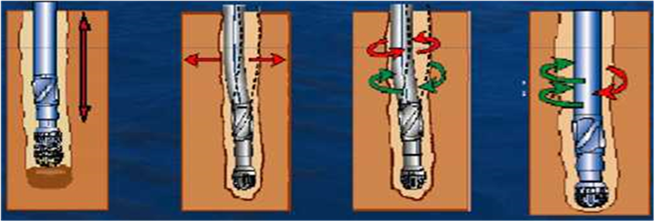
The research aims to design a methodology for applying vibration assessment matrices to the drill string during drilling to optimize drilling parameters and string performance; optimize the ROP of the well being drilled; and, in some cases, prevent entrapment or hole collapse due to mechanical effects. This is a projective study that addresses drill string vibrations using documentary and observational techniques for data acquisition. The methodology will be developed in phases: first, research and collection of well data and existing literature; then, classification of the information and analysis of vibration assessment criteria used by different companies. Subsequently, the operational ranges of these companies will be compared to establish a unified method for determining the specific vibration type using real-time recordings (LWD/MWD) and proposing solutions or guidelines. Finally, mechanical vibration assessment matrices will be designed for the drill string, classified by strength and type of vibration (axial, torsional, or lateral), using the studied well profiles as a reference. Once the vibration value has been identified, a real-time recommendation will be issued to correct the anomalies or continue drilling.
Downloads
References
Bukowitz, D., Morán, J., Bravo, R. (2008). Programa computacional para predecir las frecuencias y modos de vibración transversales en sartas de perforación mediante el método de elementos finitos y análisis modal, Revista Técnica de la Facultad de Ingeniería Universidad del Zulia, 31(2)
Esmaeili, A. et al. (2012). Laboratory scale control of drilling parameters to enhance rate of penetration and reduce drill string vibration, SPE Saudi Arabia Section Technical Symposium and Exhibition, Al-Khobar, Saudi Arabia.
Malik, A. (2015). Propuesta de un ensamblaje de fondo para minimizar el impacto de las vibraciones en pozos de Campo Boscán. Tesis. Universidad del Zulia.
McCann, M. y Shah, H. (1979). Determining strong-motion duration of earthquakes. Bulletin of the Seismological Society of America, 6(4), 1253-1265.
McDonal J., Cedro, Y. (2010). Vibración en la sarta de perforación. Tesis. UNAM, 187
Navarro-Lopez, E, Suarez, R. (2005). Vibraciones mecánicas en una sarta de perforación: problemas de control. Revista Iberoamericana de Automática e Informática Industrial. 2(1), 43-54.
Song, J. et al. (2024) The state-of-the-art review on the drill pipe vibration. Geoenergy Science and Engineering, 243, 213337.
Teale, R. (1965). The Concept of Specific Energy in Rock Drilling. International Journal of Rock Mechanics and Mining Sciences & Geomechanics Abstracts 2, (1), 57–73.
Yaveri, M., Damani, K., Kalbhor,H. (2010). Solutions to the Down Hole Vibrations During Drilling. SPE 136956, 5.
Copyright (c) 2025 Juan Ernesto Zambrano Govea, Jesús Enrique Quintero Luzardo, Maribel Colina, Egda Marina Prieto

This work is licensed under a Creative Commons Attribution-NonCommercial-ShareAlike 4.0 International License.
Copyright
La Revista Técnica de la Facultad de Ingeniería declara que los derechos de autor de los trabajos originales publicados, corresponden y son propiedad intelectual de sus autores. Los autores preservan sus derechos de autoría y publicación sin restricciones, según la licencia pública internacional no comercial ShareAlike 4.0









_2.04__.27_p__._m__.__.png)