Eficácia de extratos de tomate orgánicos adicionados a cultivos de células de levadura contra la toxicidad por H₂O₂
Resumen
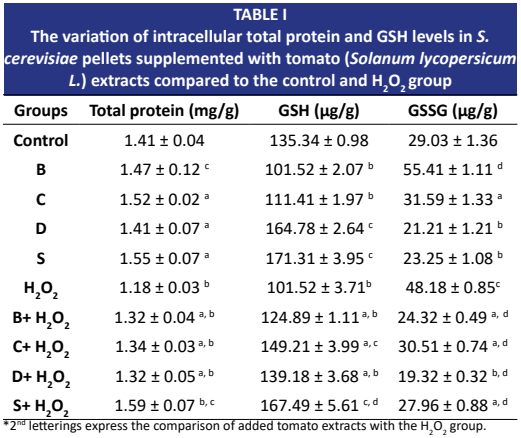
El cultivo de tomates en temporada y orgánicamente es un factor importante para obtener frutos con mayor propiedades antioxidantes. Este estudio tuvo como objetivo demostrar el efecto protector de los extractos obtenidos de tomates de cultivo natural, ampliamente utilizados como alimento, contra el daños oxidativo causado por el peróxido de hidrógeno en células de levadura (Saccharomyces cerevisiae L.). El contenido de vitaminas lipofílicas, fitosterol, glutatión y disulfuro de glutatión se analizaron mediante la cromatografía líquida de alta resolución Shimadzu, mientras que el análisis de ácidos grasos se realizó mediante cromatografía de gases Shimadzu GC 2010 Plus. El contenido de proteínas se analizó espectrofotométricamente. Los grupos de estudio se diseñaron como control, peróxido de hidrógeno, tomate y tomate + peróxido de hidrógeno.En todos los grupos adicionados con peróxido de hidrógeno y extracto de tomate, en comparación con el grupo peróxido de hidrógeno, se observó un aumento significativo en los niveles de vitamina D₂, α-tocoferol, β-sitosterol y estigmasterol. De nuevo, se observó un aumento significativo en el nivel de ergosterol en el grupo D+ peróxido de hidrógeno en comparación con el grupo peróxido de hidrógeno. Al examinar los resultados del análisis de ácidos grasos, se determinó que en todos los grupos que añadieron extractos de tomate y peróxido de hidrógeno a la levadura cultivada (excepto el grupo B + peróxido de hidrógeno), se observaron aumentos en los niveles de ácidos grasos 16:0, 16:1, n-7, 17:0, 17:1 y 18:0 en comparación con el grupo peróxido de hidrógeno. Por otro lado, al examinar su efecto sobre los niveles de proteína y glutatión, se observaron aumentos más significativos en todos los grupos con adición de extracto de tomate en comparación con el grupo peróxido de hidrógeno. Al final del estudio, se observó que los extractos de tomate tuvieron efectos positivos contra la toxicidad del peróxido de hidrógeno en las células de levadura, aunque con diferentes niveles en cuanto al contenido de ácidos grasos, vitaminas y fitosterol.
Descargas
Citas
Jamieson DJ. Oxidative stress responses of the yeast Saccharomyces cerevisiae. Yeast. [Internet]. 1998; 14(16):1511–1527. doi: https://doi.org/fqsdj5 DOI: https://doi.org/10.1002/(SICI)1097-0061(199812)14:16<1511::AID-YEA356>3.0.CO;2-S
Kurutas EB. The importance of antioxidants which play the role in cellular response against oxidative/nitrosative stress: current state. Nutr. J. [Internet]. 2015; 15:71. doi: https://doi.org/gfxffj DOI: https://doi.org/10.1186/s12937-016-0186-5
Aouacheri O, Saka S, Krim M, Messaadia A, Maidi I. The Investigation of the Oxidative Stress-Related Parameters in Type 2 Diabetes Mellitus. Can. J. Diabetes. [Internet]. 2015; 39(1):44–49. doi: https://doi.org/g54953 DOI: https://doi.org/10.1016/j.jcjd.2014.03.002
Dröge, W. Free radicals in the physiological control of cell function. Physiol. Rev. [Internet]. 2002; 82(1):47–95. doi: https://doi.org/gjn29d DOI: https://doi.org/10.1152/physrev.00018.2001
Can A, Özçelik B, Güneş G. Antioxidant capacities of fruits and vegetables: GAP 4th Agriculture Congress; 2005 Sep 21-23, Şanlıurfa, Turkey, Harran University, Faculty of Agriculture.
Costa V, Moradas-Ferreira P. Oxidative stress and signal transduction in Saccharomyces cerevisiae: insights into ageing, apoptosis and diseases. Mol. Aspects Med. [Internet]. 2001; 22(4-5):217-246. doi: https://doi.org/bv6r79 DOI: https://doi.org/10.1016/S0098-2997(01)00012-7
Durmuş M, Yetgin O, Abed MM, Haji EK, Akçay K. Tomato Plant, Evaluation in terms of Nutrient Content and Healthy. Int. J. Life Sci. Biotechnol. [Internet]. 2018; 1(2):59-74. doi: https://doi.org/q2wr DOI: https://doi.org/10.38001/ijlsb.482443
Barros L, Dueñas M, Pinela J, Carvalho AM, Buelga CS, Ferreira ICFR. Characterization and quantification of phenolic compounds in four tomato (Lycopersicon esculentum L.) farmers’ varieties in Northeastern Portugal homegardens. Plant Foods Hum. Nutr. [Internet]. 2012; 67(3):229-234. doi: https://doi.org/f38fbd DOI: https://doi.org/10.1007/s11130-012-0307-z
Lodish H, Berk A, Zipursky LS, Matsudaira P, Kaiser CA, Krieger M, Scott MP, Darnel J. Molecular Cell Biology, 5th edition, New York, USA: W. H. Freeman & Company; 2004 [cited 20 Nov 2025]. Available in: https://goo.su/julroD
Ulaş M. The metabolic effects of overexpression of Gcr1p transcription factor in Saccharomyces Cerevisiae. [Bachelor’s Thesis on the Internet]. Bursa, Türkiye: University of Uludağ; 2015 [cited 8 Sep 2025]. 55 p. Available in: https://goo.su/fFzr5
Ribeiro IC, Verissimo I, Moniz L, Cardoso H, Sousa MJ, Soares AMVM, Leão C. Yeasts as A Model for Assessing The Toxicity of The Fungicides Penconazol, Cymoxanil and Dichlofluanid. Chemosphere. [Internet]. 2000; 41(10):1637-1642. doi: https://doi.org/cpkcvf DOI: https://doi.org/10.1016/S0045-6535(00)00039-4
Colvine S, Branthome X. The Tomato: A Seasoned Traveller. Compendium of Plant Genomes. In: Causse M, Giovannoni J, Bouzaye M, Zouine M, editors. The Tomato Genome. Berlin, Heidelberg: Springer; 2016. p.1-5. doi: https://doi.org/q2xt DOI: https://doi.org/10.1007/978-3-662-53389-5_1
Slimestad R, Verheul M J. Review of flavonoids and other phenolics from fruits of different tomato (Lycopersicon esculentum mill.) cultivars. J. Sci. Food Agric. [Internet]. 2009; 89(8):1255–1270. doi: https://doi.org/bf9hqz DOI: https://doi.org/10.1002/jsfa.3605
Elsekran M. Allelopathic Effects of Some Cruciferous Species as Pre-Plants and Control Methods Opportunities On Johnsongrass (Sorghum Halepense L.) Pers.) In Tomato (Lycopersicon Esculentum L.) Cultivation [doctoral thesis on the Internet]. Kahramanmaraş, Türkiye: University of Kahramanmaras Sutcu Imam; 2022 [cited 10 Sep 2025]. 151 p. Available in: https://goo.su/mM2yaU
Yong KT, Yong PH, Ng ZX. Tomato and human health: A perspective from post-harvest processing, nutrient bio-accessibility, and pharmacological interaction. Food Front. [Internet]. 2023; 4(4):1702-1719. doi: https://doi.org/q2xx DOI: https://doi.org/10.1002/fft2.299
Gorecka D, Wawrzyniak A, Jędrusek-Golińska A, Dziedzic K, Hamułka J, Kowalczewski PŁ, Walkowiak J. Lycopene in tomatoes and tomato products. Open Chem. [Internet]. 2020; 18(1): 752–756. doi: https://doi.org/q2x2 DOI: https://doi.org/10.1515/chem-2020-0050
Caseiro M, Ascenso A, Costa A, Creagh-Flynn J, Johnson M, Simões S. Lycopene in human health. LWT. [Internet]. 2020; 127:109323. doi: https://doi.org/gr4f9r DOI: https://doi.org/10.1016/j.lwt.2020.109323
Gholami F, Antonio J, Evans C, Cheraghi K, Rahmani L, Amirnezhad F. Tomato powder is more effective than lycopene to alleviate exercise-induced lipid peroxidation in well-trained male athletes: Randomized, double-blinded cross-over study. J. Int. Soc. Sports Nutr. [Internet]. 2021; 18(1):17. doi: https://doi.org/gq8vhd DOI: https://doi.org/10.1186/s12970-021-00415-7
Song B, Liu K, Gao Y, Zhao L, Fang H, Li Y, Pei L, Xu Y. Lycopene and Risk of Cardiovascular Diseases: A Meta-Analysis of Observational Studies. Mol. Nutr. Food Res. [Internet]. 2017; 61(9):1601009. doi: https://doi.org/q2x3 DOI: https://doi.org/10.1002/mnfr.201601009
Cheng HM, Koutsidis G, Lodge JK, Ashor AW, Siervo M, Lara J. Lycopene and Tomato and Risk of Cardiovascular Diseases: A Systematic Review and Meta-Analysis of Epidemiological Evidence. Crit. Rev. Food Sci. Nutr. [Internet]. 2019; 59(1):141–158. doi: https://doi.org/grb6kt DOI: https://doi.org/10.1080/10408398.2017.1362630
Collins EJ, Bowyer C, Tsouza A, Chopra M. Tomatoes: An Extensive Review of the Associated Health Impacts of Tomatoes and Factors That Can Affect Their Cultivation. Biology. [Internet]. 2022; 11(2):239. doi: https://doi.org/gptq7c DOI: https://doi.org/10.3390/biology11020239
Engindeniz, S. Economic analysis of pesticide use on processing tomato growing: a case study for Turkey. Crop. Prot. [Internet]. 2006; 25(6):534–541. doi: https://doi.org/b5tx74 DOI: https://doi.org/10.1016/j.cropro.2005.08.009
Gönaylı S, Temizer A, Aydın S, Kırmızıkaya G, Okutan T, Yilmaz O. Comparison of Antioxidant Activities of Organic Tomato (Solanum Lycopersicum L.) and Red Pepper (Capsicum Annuum L.) Extracts Against H2O2 Toxicity. In: Akkoyun HT, Güven EB, editors. Conference proceedings book. 9th International Conference On Medical & Health Sciences; 2025 May 15-19, Dubai, UAE. New York, USA: Liberty Academic Publishing. 2025 [cited 20 Nov 2025]. p. 345-359. Available in: https://goo.su/KFmzHb
Lopez-Rojas AZ, Lescano-Rodríguez C, Alvarez-Fernandez EYM, García-Peña DY, López-Alayo KF, Silva-Chuquipoma DH. Growth Kinetics of Saccharomyces cerevisiae in Tomato Dressing. 22nd LACCEI International Multi-Conference for Engineering, Education, and Technology; July 17 – 19, 2024. San Jose, Costa Rica: LACCEI. doi: https://doi.org/q2x5 DOI: https://doi.org/10.18687/LACCEI2024.1.1.123
Dilsiz N, Çelik S, Yilmaz Ö, Digrak M. The Efects of Selenium, Vitamin E and their Combination on the Composition of Fatty Acids and Proteins in Saccharomyces cerevisiae. Cell Biochem. Funct. [Internet]. 1997; 15(4):265-269. doi: https://doi.org/c4wvcd DOI: https://doi.org/10.1002/(SICI)1099-0844(199712)15:4<265::AID-CBF750>3.0.CO;2-D
Aydin S, Yilmaz Ö, Gökçe Z. Effectiveness of matured Morus nigra L. (blackmulberry) fruit extract on 2,2-diphenyl-1-picrylhydrazyl (DPPH.) and hydroxyl (OH.) radicals as compared to less matured fruit extract. Afr. J. Biotechnol. [Internet]. 2011 [cited 22 Nov 2025]; 10(71):16037-16044. Available in: https://goo.su/Celc
Lowry OH, Rosenbrough NJ, Farr AL, Randall R. Protein measurement with the Folin-phenol reagent. J. Biol. Chem. [Internet]. 1951 [cited 1 Nov 2025]; 193(1):265-275. Available in: https://goo.su/sTm1h DOI: https://doi.org/10.1016/S0021-9258(19)52451-6
Yilmaz O, Keser S, Tuzcu M, Guvenc M, Cetintas B, Irtegun S, Tastan H, Sahin K. A Practical HPLC Method to Measure Reduced (GSH) and Oxidized (GSSG) Glutathione Concentrations in Animal Tissues. J. Anim. Vet. Adv. [Internet]. 2009 [cited 18 Sept 2025]; 8(2):343-347. Available in: https://goo.su/r5BYaUh
Hara A, Radin NS. Lipid extraction of tissues with a low-toxicity solvent. Anal. Biochem. [Internet]. 1978; 90(1):420–426. doi: https://doi.org/b3c4h8 DOI: https://doi.org/10.1016/0003-2697(78)90046-5
Sánchez-Machado DI, López-Hernández J, Paseiro-Losada P. High performance liquid chromatographic determination of alpha-tocopherol in macroalgae. J. Chromatogr. A. [Internet]. 2002; 976(1-2):277–284. doi: https://doi.org/b549kf DOI: https://doi.org/10.1016/S0021-9673(02)00934-2
Tvrzicka E, Vecka M, Stankova B, Zak A. Analysis of fatty acids in plasma lipoproteins by gas chromatography-flame ionisation detection: Quantative Aspectes. Anal. Chim. Acta. [Internet]. 2002; 465(1-2):337-350. doi: https://doi.org/d624gw DOI: https://doi.org/10.1016/S0003-2670(02)00396-3
Sönmez K, Ellialtioglu S. Dometes, karotenoidler ve bunlari etkileyen faktörler üzerine bir inceleme. Derim. [Internet]. 2014; 31(2):107-130. doi: https://doi.org/gp32sh DOI: https://doi.org/10.16882/derim.2014.32662
Ochoa-Velasco CE, Valadez-Blanco R, Salas-Coronado R Sustaita-Rivera F, Hernández-Carlos B, García-Ortega S, Santos-Sánchez NF. Effect of nitrogen fertilization and Bacillus licheniformis biofertilizer addition on the antioxidants compounds and antioxidant activity of greenhouse cultivated tomato fruits (Solanum lycopersicum L. var. Sheva). Sci. Hortic. [Internet]. 2016; 201:338–345. doi: https://doi.org/f8hv4d DOI: https://doi.org/10.1016/j.scienta.2016.02.015
Folmer V, Pedroso N, Matias AC, Lopes SCDN, Antunes F, Cyrne L, Marinho HS. H2O2 induces rapid biophysical and permeability changes in the plasma membrane Saccharomyces cerevisiae. Biochim. Biophys. Acta Biomembr. [Internet]. 2008; 1778(4):1141–1147. doi: https://doi.org/b7sff5 DOI: https://doi.org/10.1016/j.bbamem.2007.12.008
Matias AC, Pedroso N, Teodoro N, Marinho HS, Antunes F, Nogueira JM, Herrero E, Cyrne L. Down-regulation of fatty acid synthase increases the resistance of Saccharomyces cerevisiae cells to H2O2. Free Radic. Biol. Med. [Internet]. 2007; 43:1458-1465. doi: https://doi.org/b8ttx9 DOI: https://doi.org/10.1016/j.freeradbiomed.2007.08.003
Torija MJ, Beltron G, Novo M, Poblet M, Guillaman JM, Mas A, Rozes N. Effects of fermentation temperature and Saccharomyces species on the cell fatty acid composition and presence of volatile compounds in wine. Int. J. Food Microbiol. [Internet]. 2003; 85(1-2):127-136. doi: https://doi.org/cwcwmm DOI: https://doi.org/10.1016/S0168-1605(02)00506-8
Lamacka M, Sajbidor J, Bohov P. Lipid isolation and fatty acid analysis in Saccharomyces cerevisiae. Comparison of different methods. Biotechnol. Tech. [Internet]. 1998 [cited 20 Nov 2025]; 12:621-625. Available in: https://goo.su/Wqsmo DOI: https://doi.org/10.1023/A:1008832013587
Malo I, De Bastiani M, Arevalo P, Bernacchia G. Natural extracts from pepper, wild rue and clove can activate defenses against pathogens in tomato plants. Eur. J. Plant Pathol. [Internet]. 2017; 149:89-101. doi: https://doi.org/q2zb DOI: https://doi.org/10.1007/s10658-017-1168-y
Kaya K, Al-Remi F, Arvas YE, Durmus M. Tomato Plant and Its in Vitro Micropropagation. J. Eng. Technol. Appl. Sci. [Internet]. 2018; 3(1):55-73. doi: https://doi.org/q2zc DOI: https://doi.org/10.30931/jetas.418758
Barba AO, Hurtado MC, Sánchez-Mata MC, Fernández-Ruiz V, Tejada ML. Application of a UV–vis detection-HPLC method for a rapid determination of lycopene and ß-carotene in vegetables. Food Chem. [Internet]. 2006; 95(2):328-336. doi: https://doi.org/bvdvv3 DOI: https://doi.org/10.1016/j.foodchem.2005.02.028
Aksu Z, Eren AT. Production of carotenoids by the isolated yeast of Rhodotolura glutinis. Biochem. Eng. J. [Internet]. 2007; 35(2):107-113. doi: https://doi.org/bfvzx8 DOI: https://doi.org/10.1016/j.bej.2007.01.004